Looking back at my recent posts about hiking in the Peak District, I’ve noticed that I make a lot of references to things that the scenery reminds me of. This is just how my mind works: finding connections and then making other connections from those, until things sometimes get very obscure.
For example, I was very tempted to share this nice picture of morning mist over the distant Derwent Valley on social media with the caption "Just like Beggar’s Canyon back home!" and no other explanation.
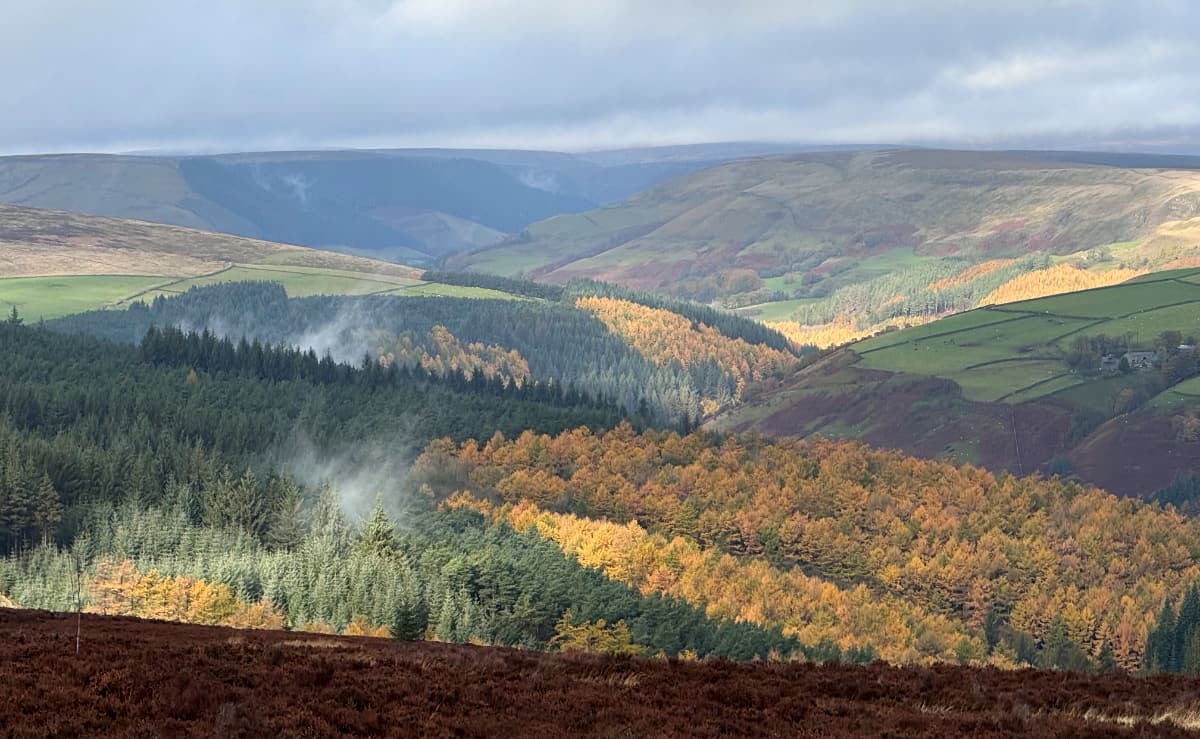
Most of you will be wondering what I’m talking about, as these are valleys rather than canyons. Where's Beggar's Canyon anyhow? Well, here’s what I was trying to convey:
- In World War II, the UK's Royal Air Force wanted to destroy the dams at the head of Germany's Ruhr Valley, but they were too strongly built and heavily defended for a regular attack.
- To destroy these dams, British engineers invented a novel kind of bomb that would bounce along the water like a skipping stone, avoiding nets and other defences, and then sink against the base of the dam before exploding.
- To be effective, these bombs would have to be dropped from a Lancaster heavy bomber at a speed of exactly 240mph from an altitude of exactly 60 feet and at a precise distance from the target.
- To manage such a precision attack over water using specialized range and altitude finders, the flight crews needed a lot of training. One of the places where they practiced was the Derwent Reservoir, which (if I read my maps correctly) can be seen curving off to the right in the background of my photo.
- In May 1943, all that training paid off, as Operation Chastise succeeded (at great cost) in breaching two of the dams and flooding large areas of the Ruhr Valley.
- In 1955, a movie was made about the mission, called The Dam Busters. It is a classic war film, and considered one of the greatest British films of the 20th century. Much of the film is a “triumph of the nerds” story about a tenacious engineer who convinces the RAF to try his daring idea, and the teams that figure out all the technical challenges. Then the film finishes with a thrilling recreation of the dam attack – much of it also shot in the Derwent Valley.
- In the 1970s, as George Lucas worked on his space opera Star Wars, he used footage from World War II movies extensively to help visualize the dogfights. In particular, in planning out the final battle, where attack ships try to hit a very small target at the end of a narrow heavily defended trench, Lucas used clips from 633 Squadron and The Dam Busters.
- Lucas ended up keeping much of the choreography and even the dialogue from The Dam Busters in the final film. Here’s a fun YouTube video highlighting the parallels between the attacks against the Ruhr dams and the Death Star exhaust port.
- As the hero Luke Skywalker gets ready for his final attack run into the Death Star trench, he is reminded of the flying hot rod drag races he used to do back on Tatooine, and how they were like a rehearsal for exactly this mission, and muses:
“It’ll be just like Beggar’s Canyon back home!”
So that’s how my mind works: a view of a scenic misty valley combines with some information I read on a plaque nearby and triggers a chain of associations across 80 years of history, two iconic films, and (of course) Luke Skywalker.